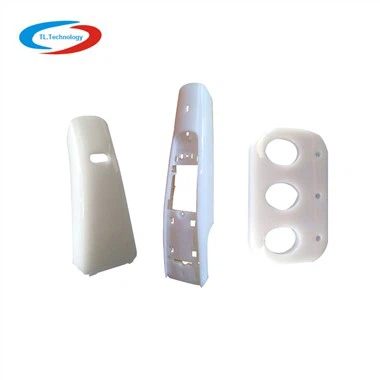
Plastic mold is an abbreviation of a combined mold used for compression molding, extrusion molding, injection, blow molding and low foam molding. The coordinated changes of the mold convex and concave molds and the auxiliary molding system can process a series of plastic parts of different shapes and different sizes.
Plastic molds are the mother of industry, and the release of new products will involve plastics.
It mainly includes a concave mold with a variable cavity composed of a female mold combined substrate, a female mold component and a female mold combined card board, and a convex mold combined substrate, a male mold component, a male mold combined card board, a cavity cutting component and A punch with a variable core composed of side-cut composite plates.
In order to improve the performance of plastics, various auxiliary materials, such as fillers, plasticizers, lubricants, stabilizers, colorants, etc., must be added to the polymer to become plastics with good performance.
1. Synthetic resin is the most important component of plastics, and its content in plastics is generally 40% to 100%. Because of the large content and the nature of the resin often determines the nature of the plastic, people often regard the resin as a synonym for plastic. For example, confuse polyvinyl chloride resin with polyvinyl chloride plastics, and phenolic resins with phenolic plastics. In fact, resin and plastic are two different concepts. Resin is an unprocessed raw polymer that is not only used to make plastics, but also a raw material for coatings, adhesives, and synthetic fibers. In addition to a very small part of plastics that contain 100% resin, most plastics need to add other substances in addition to the main component resin.
2. Packing
Fillers are also called fillers, which can improve the strength and heat resistance of plastics and reduce costs. For example, the addition of wood powder to the phenolic resin can greatly reduce the cost, making the phenolic plastic one of the cheapest plastics, and at the same time, it can significantly improve the mechanical strength. Fillers can be divided into two types: organic fillers and inorganic fillers, the former such as wood flour, rags, paper and various fabric fibers, and the latter such as glass fiber, diatomaceous earth, asbestos, carbon black and so on.
3. Plasticizer
Plasticizers can increase the plasticity and flexibility of plastics, reduce brittleness, and make plastics easier to process and shape. Plasticizers are generally high-boiling organic compounds that are miscible with resin, non-toxic, odorless, and stable to light and heat. The most commonly used are phthalate esters. For example, in the production of polyvinyl chloride plastics, if more plasticizers are added, soft polyvinyl chloride plastics can be obtained. If no or less plasticizers are added (amount <10%), rigid polyvinyl chloride plastics can be obtained. .
4. Stabilizer
In order to prevent the synthetic resin from being decomposed and damaged by light and heat during processing and use, and to prolong its service life, stabilizers should be added to the plastic. Commonly used are stearate, epoxy resin and so on.
5. Coloring agent
The colorant can make the plastic have various bright and beautiful colors. Commonly used organic dyes and inorganic pigments as colorants.
6. Lubricant
The role of the lubricant is to prevent the plastic from sticking to the metal mold during molding, and to make the surface of the plastic smooth and beautiful. Commonly used lubricants include stearic acid and its calcium and magnesium salts. In addition to the above additives, flame retardants, foaming agents, antistatic agents, etc. can also be added to the plastic.
Hot Tags: home appliance plastic parts injection mold manufacturer, China, suppliers, manufacturers, factory, custom, wholesale, buy, made in China